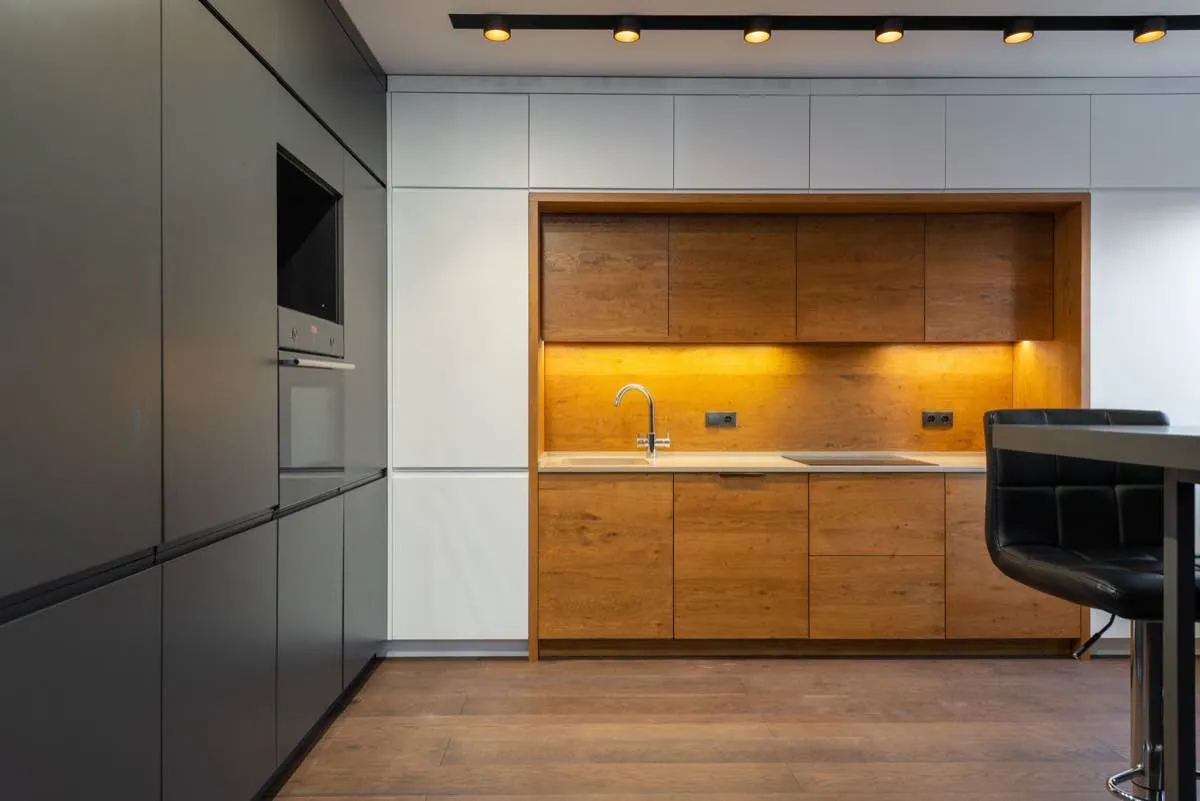
The best kitchen cabinet organization move is converting base cabinets from doors-with-a-shelf into drawers or pull-outs — everything else is a distant second. Nearly every storage complaint we hear is an access problem dressed up as a space problem. You have room. You just can't reach it.
The base cabinet with a door and one fixed shelf is the single worst storage design still in mass production. To get the pot at the back you kneel on the floor, tilt your head sideways, and excavate. Meanwhile the back eight inches of that cabinet functions as a small museum of things you bought once.
Start by fixing access, not by buying bins
Before anything else, a quick audit. Open every base cabinet and ask one question: can I see everything in here without moving something? Wherever the answer is no, that's where the money goes.
The fix hierarchy, in order of return:
- Drawers instead of doors in base cabinets
- Pull-out shelves where drawers aren't feasible
- A corner solution for the blind corner
- Vertical dividers for trays, sheets, and cutting boards
- A pull-out trash unit, which frees floor space you didn't know you were spending
- Then, and only then, the drawer inserts and bins
Most people do that list backwards, which is how you end up with a very organized cabinet you still can't reach into.
What each upgrade costs
| Upgrade | Retrofit installed | Factory-integrated |
|---|---|---|
| Single pull-out shelf | $150–$350 | $75–$250 per cabinet |
| Full drawer-base conversion | Often not practical | $200–$600 per cabinet |
| Pull-out trash, 15 or 18 in | $200–$450 | $150–$400 |
| Lazy susan, corner | $150–$400 | $150–$350 |
| Blind corner pull-out | $400–$900 | $350–$800 |
| Tray and sheet dividers | $60–$200 | $50–$175 |
| Toe-kick drawer | $250–$600 | $200–$450 |
| Drawer inserts and dividers | $20–$150 each | Similar |
| Pull-out spice rack, 6 or 9 in | $120–$300 | $100–$250 |
Rev-A-Shelf and Hafele make most of what you'll see in a showroom, and both make good hardware. The number to look at is the slide weight rating: 75 to 100 pounds and full-extension for anything that will hold a stand mixer or cast iron. That rating is where the price difference lives, and it's the difference between a pull-out that still works in year eight and one that binds in year two.
Sizes worth knowing before you buy anything
- Most pull-out systems need about 21 inches of clear interior width to be worth installing, and they eat roughly an inch per side for slides.
- Standard base cabinets are 34.5 inches high and 24 inches deep, with a 36-inch finished counter.
- Wall cabinets are usually 12 inches deep, which is why a dinner plate barely fits.
- Trash pull-outs come in 15-inch single and 18-inch double as the common sizes.
- There are 4 to 6 inches of dead height in the toe kick under every base cabinet in your kitchen.
Measure the clear interior width, not the door. Face frames steal an inch or more on each side, and a lot of disappointing organizer purchases trace back to that one detail.
Organize by task, not by object
Once you can reach things, put them where they get used. The standard zones:
- Prep: knives, boards, bowls, and the trash pull-out, all within a step of the main counter
- Cook: pots, pans, oils, utensils, all beside the range
- Bake: sheets, mixer, flour and sugar, ideally in a deep drawer near the oven
- Clean: dish soap, cloths, and the dishwasher-adjacent cabinet for everyday plates
- Store: everything you use less than monthly, up high or way down low, where it belongs
Everyday dishes should live where you unload the dishwasher, not where dishes traditionally go. That single change saves more steps per week than any insert you can buy.
Our one strong opinion
Skip the blind corner gadget and consider giving the corner up.
A blind corner pull-out costs $400 to $900, and even the good ones are a mechanism you're trusting with heavy cookware for twenty years. There's a genuinely better option in many kitchens: have the corner dead-paneled and add the storage as drawers along the accessible runs instead. You lose some cubic feet you were never really using, and everything you keep is reachable in one motion.
If you'd rather keep the corner, the honest ranking is: blind corner pull-out if the budget's there, a well-made full-round lazy susan if it isn't, and a plain shelf if you enjoy crawling. A lazy susan at $200 that you actually spin beats a $700 mechanism you're afraid to overload.
Where you should absolutely not spend money
We'd rather say this than sell you a package.
Don't buy a custom insert for a job a $30 organizer does. Drawer dividers, expandable utensil trays, tiered spice risers, under-shelf baskets, and a pan organizer from any home store solve a startling percentage of kitchen chaos for under $100 total. Try that first. Genuinely. Buy nothing custom until you've spent one weekend and forty dollars finding out what your actual problem is.
Don't buy organizers before you declutter. Every professional in this trade will tell you the same thing and everyone ignores it. Organizing things you don't use is just relocating them at a higher price per square foot.
Don't add pull-outs to cabinets you're replacing within two years. The retrofit hardware rarely transfers.
And don't retrofit a narrow cabinet. Under 21 inches, a pull-out gives you a shelf that's smaller than the shelf you had. Use it for trays or a spice pull-out instead.
Where it's genuinely worth calling someone: converting base cabinets to full drawer banks, toe-kick drawers, and anything that needs the face frame modified. Those are cabinet-shop jobs, and they're also the ones with the biggest payoff — which is why they show up when we build custom kitchen cabinets from scratch.
Bottom line
Access first, then zones, then bins. Convert doors to drawers where you can, put a pull-out where you can't, take the toe-kick space nobody uses, and spend forty dollars on off-the-shelf dividers before you spend four hundred on anything custom.
Tempe Elite Cabinets builds custom kitchen cabinetry with the pull-outs and drawer banks designed in from the start, plus built-in storage and closet systems across Tempe and the Salt River Valley. If you want a second opinion on whether your kitchen needs new cabinets or just better ones, that's a free conversation — call (855) 416-1185, or start with cabinet refacing vs replacing.
Ready for a free quote in Tempe?
Tempe Elite Cabinets — free estimate, clear scope, no pressure. Use the form on this page or jump to the homepage quote.
Related services in Tempe
Tempe Elite Cabinets money pages — go straight to the service you need.
- Custom Kitchen Cabinets →
Custom kitchen cabinets in Tempe run $15,000 to $40,000 and up for a full kitchen, and that spread has almost nothing to do with the door style you fell for online. It moves on box construction, drawer count, and whether anyone measured the walls before the order went in.
- Walk-In Closets & Wardrobes →
A custom closet system in Tempe is usually an exercise in making a 1960s reach-in behave like a walk-in. Most of the gain comes from double-hanging, drawers where bare carpet used to be, and shelving that runs to the ceiling instead of quitting at 84 inches.
- Home Office & Built-Ins →
Home office built-ins are the best money you can spend on a spare bedroom in a Tempe ranch, and they run $4,500 to $12,000 for a full wall depending on length and whether the doors get painted or stained. A desk that's scribed into the room gives you eight or ten more usable inches than furniture ever will.
- Bathroom Vanities →
Bathroom vanity cabinets take more abuse than anything else we build in Tempe, because they swing from 12 percent humidity in June to a wet towel hanging off the door every night of the year. We size them to the room rather than to a catalog, which in a Hayden Ferry condo bathroom rarely means the 21-inch standard depth.
- Garage Cabinets & Storage →
Garage cabinets and storage in Tempe have to survive an unconditioned room that hits 120 degrees in August, and that single fact rules out most of what gets sold as garage cabinetry. Thermofoil doors peel at that temperature, particleboard shelving sags under a case of bottled water, and stick-on hooks let go somewhere around the second summer.
Frequently asked questions
What is the best way to organize kitchen cabinets?
Convert base cabinets from doors-with-a-shelf into drawers or pull-outs, then organize by task zone rather than by object type. Keep everything you use for one job in one place near where you do it. Almost every kitchen storage problem is really an access problem, not a volume problem.
How much do pull-out shelves cost?
Retrofit pull-out shelves that mount inside an existing cabinet run roughly $40 to $150 each in parts, or $150 to $350 each installed. Factory-integrated pull-outs specified with new cabinets typically add $75 to $250 per cabinet. A 15-inch pull-out trash unit is commonly $150 to $400.
Are lazy susans or blind corner pull-outs better?
Blind corner pull-outs get more usable storage out of the space and bring it to you rather than making you spin and reach. They also cost two to four times as much and need a specific cabinet opening. A well-made lazy susan is still a perfectly good answer for a true 90-degree corner cabinet.
Do cabinet organizers need a minimum cabinet width?
Most pull-out shelf and basket systems need at least about 21 inches of clear interior width to be worth doing, and they lose roughly an inch of width to the slides on each side. Narrow 9 and 12 inch cabinets are better used as tray dividers or a spice pull-out than as a shrunken shelf.
Are expensive cabinet organizers worth it?
The ones that carry weight are. A pull-out you load with a stand mixer and cast iron wants full-extension slides rated at 75 to 100 pounds, and that's where the price difference lives. A $20 wire basket on light-duty slides holding 30 pounds of pans will sag and bind within a year.
What is the most underrated kitchen storage upgrade?
Toe-kick drawers. There are four to six inches of dead space under every base cabinet in your kitchen, running the whole length of the run, and it's the natural home for baking sheets, platters, and the pet bowls. Most people have never considered it because it's invisible until someone points at it.
Local context
How this applies in Tempe, AZ
Every article here is written from cabinet work done in Tempe and the Salt River Valley, so the numbers reflect local labour, permit and material costs rather than a national average. Your own job can land either side of them depending on access, the condition of what is already there, and the materials you pick — furniture-grade plywood boxes, solid maple dovetail drawers, Blum and Grass soft-close hardware.
The way to turn any of this into a real answer is to have someone look at your actual situation. The free estimate is free, itemized and written down, with no deposit and no obligation. Call (855) 416-1185 or start on the Tempe Elite Cabinets homepage.
Areas Tempe Elite Cabinets covers
Tempe first, then the surrounding communities of the Salt River Valley. Each has its own page with local detail rather than a copy of this one:
- Scottsdale, AZ — Maricopa County, population 241,361
- Phoenix, AZ — Maricopa County, population 1,608,139
- Glendale, AZ — Maricopa County, population 248,325
- Peoria, AZ — Maricopa County, population 190,985
- Surprise, AZ — Maricopa County, population 143,148
- Goodyear, AZ — Maricopa County, population 95,294
Or jump to the full list of Tempe services.
More from the Tempe Elite Cabinets blog
- Cabinet Hardware Trends in Tempe Kitchens
Kitchen cabinet hardware trends in Tempe, AZ — which finishes hold up, the pull-length rule that fixes sizing, and how to swap 40 pulls yourself.
- Kitchen Cabinet Cost in Tempe: Real Ranges for 2026
Kitchen cabinets run about $100 to $1,200 per linear foot depending on tier. Honest stock, semi-custom, and custom ranges for Tempe, AZ homes.
- Custom Built-In Cabinets: Tempe Per-Foot Costs
Custom built-in cabinets in Tempe, AZ — entertainment walls, offices, mudrooms and window seats, real per-foot costs, and when furniture is smarter.
The Tempe Elite Cabinets Team
cabinet specialists serving Tempe, AZ
Written by the Tempe Elite Cabinets team — insured cabinet pros with 15+ years serving Tempe, AZ and the surrounding area.